Less Hustle for Hustle’s Sake, More Intention
Hard work can be meaningful. But constant motion is not always the same thing as progress.
There was a time when I could work for hours and feel proud of the sheer volume of things I had done.
The list was long.
The inbox was answered.
The project was moving.
The ideas were flowing.
I was tired, but I also felt accomplished. I was building something. I was making headway. I was proving—to myself and maybe to everyone else—that I was serious about my goals.
As an entrepreneur, I tried to keep that energy going.
More effort.
More output.
More hustle.
More proof.
And I burnt out more times than I can count.
Eventually, I had to ask a question that was both simple and uncomfortable:
Was I working with purpose—or was I just working because slowing down felt unsafe?
Hustle is not automatically the problem
Let’s be clear: this is not an argument against ambition.
It is not a suggestion that you should stop caring about your work, your goals, your financial stability, or the things you want to create.
Work can require effort.
Building something can require focus.
There are demanding seasons.
There are deadlines.
There are responsibilities.
There are moments when you are excited, clear, and in a creative flow that makes you want to lock in and see what you can do.
That is not the issue.
The issue is when hustle becomes the only strategy.
When overwork becomes an identity.
When being busy becomes the main way you measure whether you are doing enough.
When you keep moving because stopping might require you to notice how tired, disconnected, resentful, uncertain, or unfulfilled you have become.
Constant motion can be a form of avoidance
Sometimes we stay busy because busy is familiar.
Busy gives us a role.
Busy gives us a reason not to sit with our feelings.
Busy can make us feel important, needed, or safe.
But it can also keep us from asking questions like:
Do I actually want this?
Is this still aligned with my values?
Is this pace sustainable?
What is this costing me?
What would I do if I were not trying to prove my worth?
What am I avoiding by filling every available moment?
What would become possible if I gave myself permission to pause?
These are not easy questions.
And they are not questions that require a dramatic answer.
Sometimes the answer is simply that you need a better boundary.
Or a more realistic plan.
Or a conversation with your manager.
Or a day off.
Or help.
Or a reminder that your worth does not rise and fall with your output.
Intention is not the same as doing less
When I say “more intention,” I do not necessarily mean doing less.
Sometimes intention will lead you to do less.
You may decide a project can wait.
You may decline an opportunity that does not fit.
You may move a task to next week.
You may take a break before you reach the breaking point.
But sometimes intention will lead you to do more of the work that matters.
You may say yes to a bold opportunity.
You may commit to a creative project.
You may make a career transition plan.
You may have the conversation you have been avoiding.
You may invest energy in something because it is deeply aligned with the person you are becoming.
The difference is not the quantity of work.
The difference is whether you are choosing it with awareness.
Questions for a more intentional work life
Before you say yes to a project, opportunity, request, or expectation, pause long enough to ask:
Is this aligned with what I am building?
Does this move me toward the career, relationships, health, creative life, or community I want?
Or does it keep me busy without moving me anywhere meaningful?
Do I have capacity for this right now?
Capacity is not only about time.
It is also about energy, focus, health, emotional bandwidth, caregiving, and what else you are carrying.
A free hour on your calendar is not always available capacity.
What will this require of me?
Not only how many hours will it take.
Ask what it will require emotionally.
Will it require deep focus? Visibility? Conflict? Travel? Extra preparation? Recovery time afterward? More support?
When you name the full cost, you can make a more honest choice.
What am I making room for if I say yes?
Every yes creates something.
Maybe it creates learning, income, connection, impact, creativity, or opportunity.
Name it.
What am I giving up if I say yes?
Every yes also takes space from something else.
Maybe that is rest, family time, personal projects, health, friendship, sleep, or the flexibility to respond to life when life inevitably does something unexpected.
This does not make the yes wrong.
It makes the tradeoff visible.
Is this meaningful movement, or am I trying to feel productive?
This may be the hardest question.
Sometimes we do things because they matter.
Sometimes we do things because they make us feel like we are keeping up.
Knowing the difference can change how we spend our energy.
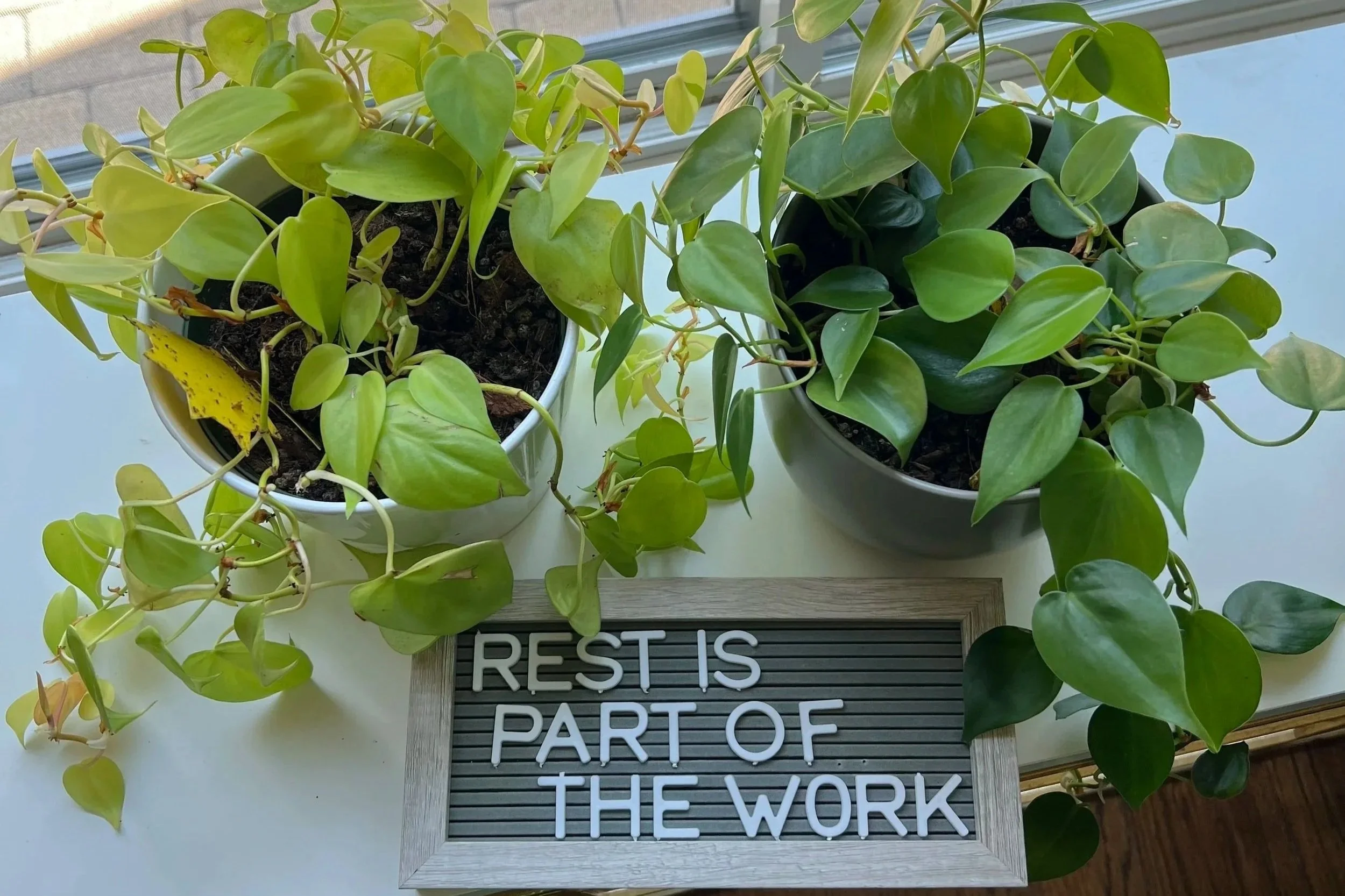
Rest is part of the work
Rest is not the reward you receive after you have proven you are tired enough.
Rest is not a luxury reserved for people who finished every task.
Rest is not a sign that you are not serious about your life.
Rest is part of how we sustain creative thought, clear decision-making, emotional regulation, relationships, health, and the ability to keep building.
In a culture that often rewards depletion, rest can be a way of refusing the lie that you must exhaust yourself to be valuable.
It can be a way of returning to your body.
Returning to your values.
Returning to your actual life.
That does not mean rest solves structural problems. People need fair pay, safety, benefits, reasonable workloads, and workplace cultures that do not treat panic as leadership.
But rest can help us recognize when something is not sustainable—and create enough space to decide what we want to do about it.
A small practice for this week
Choose one commitment, project, or task on your list.
Then ask:
Why am I doing this?
Is it aligned with what I am building?
Do I have the capacity for it right now?
What support would make it more sustainable?
If I approached this with intention rather than urgency, what would change?
You may still do the task.
You may do it differently.
You may delay it.
You may ask for help.
You may realize it never belonged on your list in the first place.
All of those are useful answers.
Less hustle for hustle’s sake.
More intention for the life you are actually trying to build.
That is not laziness.
That is care.
That is strategy.
That is Career Joy.