The Career Joy Journey: A Human Way to Move From Career Disconnection to Action

Photo by Jerry Kavan on Unsplash
There is a specific kind of Sunday-night feeling that many of us know too well.
You are not necessarily sad that the weekend is ending. You may have rested, seen people you love, handled life errands, or done absolutely nothing and honestly, good for you.
But then Monday starts creeping closer.
And with it comes that sinking feeling.
Maybe your chest gets tight when you think about your inbox. Maybe you start mentally rehearsing a conversation with your manager. Maybe you are already calculating how many meetings you have to survive before lunch. Maybe you are simply tired of being tired.
That feeling does not always mean you need to quit your job tomorrow.
But it may mean something in your work life deserves your attention.
Career joy is not escapism
When work is hard, career advice can get strangely binary.
One voice says, “Just be grateful. You have a job. Push through.”
The other says, “Quit. Follow your passion. Everything will work out.”
Neither approach always accounts for reality.
Most people cannot make career decisions in a vacuum. We have rent, healthcare, benefits, family obligations, debt, energy limits, job-market conditions, and a whole lot of emotions wrapped up in our work.
That is why I believe Career Joy is not about pretending work is always joyful.
It is not toxic positivity in a cute outfit.
Career Joy is the practice of moving through career decisions with honesty, self-compassion, strategy, and self-trust. It is the process of recognizing where you are disconnected, getting clear about what you need, and taking aligned action—even when the next step is small.
That is the purpose of the Career Joy Journey.
The five stages
1. Acknowledge: Tell the truth about what is happening
The journey starts with honesty.
What feels unsustainable, disappointing, frustrating, or misaligned in your current work life?
Maybe you are burned out. Maybe you feel underpaid, overlooked, bored, unsupported, or disconnected from the work you once loved. Maybe you have outgrown a role that once fit. Maybe the work is fine, but the way it is structured is costing you too much.
Before you fix anything, name it.
Acknowledging your emotions is not unprofessional. It is information.
Try asking:
What am I feeling when I think about work?
Where do I notice that feeling in my body?
What is this emotion trying to help me notice?
What have I been minimizing or pretending does not matter?
You do not need to make a dramatic decision from every hard feeling. But you do deserve to listen to yourself.
2. Release: Put down what is no longer yours to carry
This is the part where we make a little room.
Many of us carry old ideas about what success should look like: a certain title, a salary number, working ourselves to exhaustion, being the dependable one, or staying loyal no matter what it costs.
We may also carry shame about career choices, fear of disappointing people, comparison, or an identity tied to being “the person who can handle anything.”
Release asks:
What am I holding onto that is keeping me stuck?
This is not about suddenly becoming fearless. It is about recognizing that some of what feels like a hard career constraint may actually be an old story.
You can thank past versions of yourself for getting you here while still choosing something different now.
3. Reimagine: Define what career joy looks like for you
Once there is space, you can get curious.
Career joy is not one universal job title or a particular salary. It is personal.
For one person, it may mean more autonomy. For someone else, it may mean stability, creative work, better boundaries, community, remote flexibility, leadership growth, a shorter commute, a healthier manager, or enough rest to actually enjoy life outside of work.
Ask yourself:
What do I value most in this season?
What do I need in order to feel safe, supported, and well?
What strengths do I want to use more often?
What boundaries or conditions are non-negotiable?
What do I want work to feel like?
This is where you stop only asking, “What job should I get?” and begin asking, “What kind of life am I trying to build?”
4. Navigate: Make decisions without spiraling
Clarity does not always create an obvious answer.
You may know you need more income and more rest. You may want to leave but need to preserve benefits. You may feel called toward a new field but have real questions about training, timing, and money.
That is where navigation comes in.
Navigation means identifying realistic paths, gathering information, weighing tradeoffs, and getting support. It means distinguishing between a fear-based limit—“I could never do that”—and a real constraint that needs a plan.
This stage may include:
Researching roles, industries, or salary ranges
Updating your résumé and LinkedIn profile
Talking with people in work you are curious about
Exploring an internal move
Evaluating your finances and benefits
Seeking therapy, mentorship, or coaching
Having a direct conversation about expectations or boundaries
You are not behind because you need time to think. You are building a path with your eyes open.
5. Move Forward: Turn insight into action
Eventually, reflection needs movement.
But movement does not need to mean a dramatic resignation letter, a brand-new identity, and a three-month solo trip to “find yourself.”
Sometimes moving forward looks like:
Sending one networking message
Updating one section of your résumé
Blocking time to rest
Applying for one role
Starting a savings plan
Asking for more clarity at work
Setting one boundary
Taking a class
Talking to someone you trust
Career joy is built through aligned action, not perfect action.
The journey is not linear
My original Career Joy Roadmap showed a winding path from Career Despair to Career Joy, and I still believe that is true: the movement is rarely a straight line.
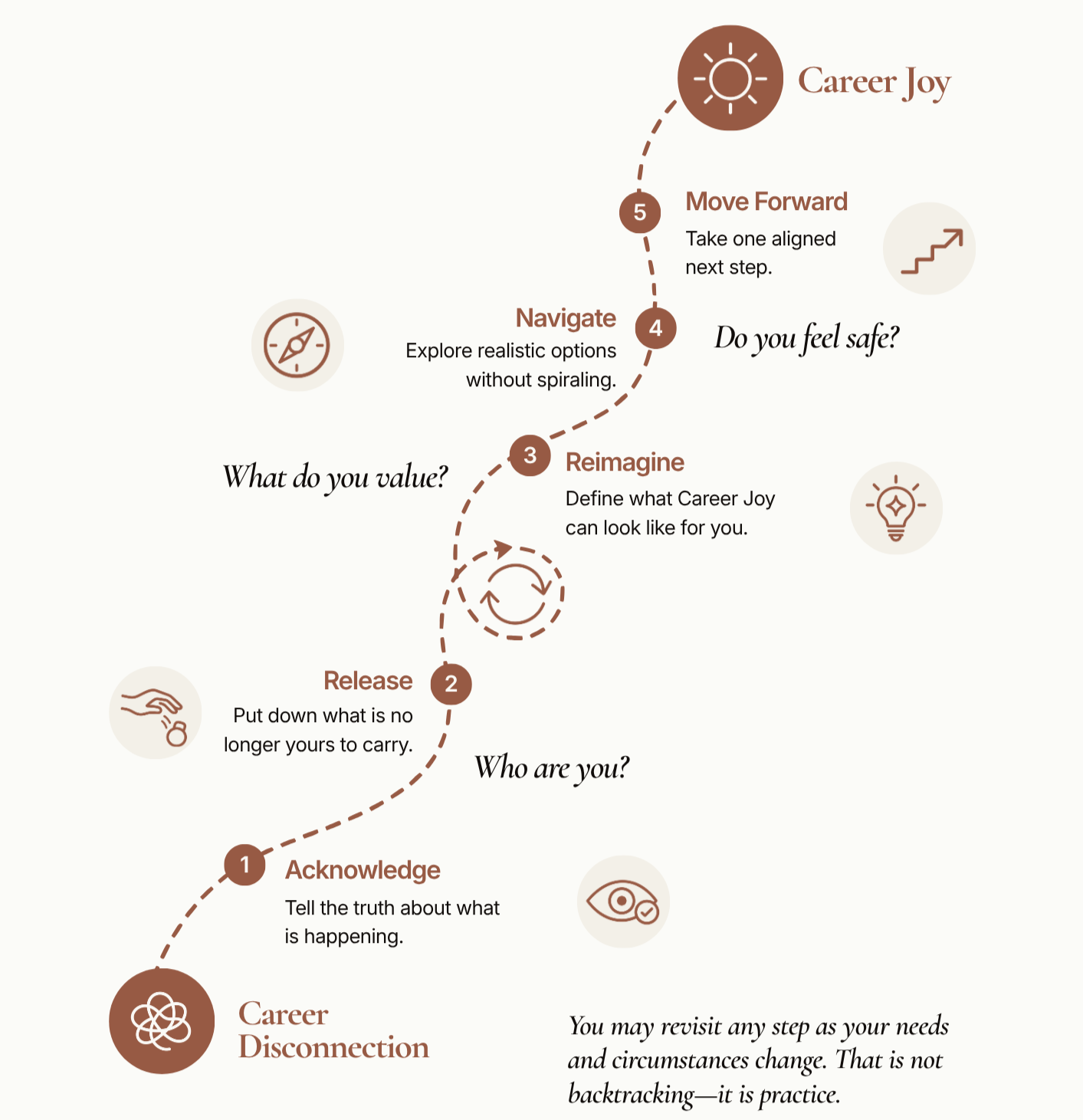
You may take action and realize you need to reimagine. You may release an old expectation and uncover emotions that need acknowledging. You may find a new job and still need to renegotiate your boundaries.
That is not backtracking.
That is the practice.
The goal is not to arrive at some permanently joyful, conflict-free career where every meeting has perfect lighting and nobody ever sends a “quick question” at 4:57 p.m.
The goal is to build a relationship with your career where you can hear yourself, trust yourself, and move with intention.
Start where you are
You do not need to have the whole plan today.
Start with one honest question:
What part of my work life needs my attention right now?
Then let yourself answer.
The Career Joy Journey begins there.